Silicone Antistatic Agent | Internal Mix Antistatic Additive for HCR & LSR Silicone
If you are manufacturing silicone parts for electronics, semiconductors and precision instruments, static electricity is one of your most annoying hidden risks.
Ordinary silicone rubber is highly insulating. Static charge easily accumulates on the silicone surface. Your finished silicone gaskets, protective sleeves and silicone films keep attracting dust and fine particles during production and packaging. Static discharge may damage sensitive electronic chips, PCBA components and optical modules, leading to latent failure and high reject rate. Many traditional antistatic additives are humidity-dependent, easy to bloom, will contaminate contact components, inhibit platinum curing, turn transparent silicone yellow, or greatly reduce the original tensile and tear properties of silicone. You need a compatible, stable, non-polluting internal antistatic additive that can dissipate static safely and keep your silicone parts clean and ESD-compliant.
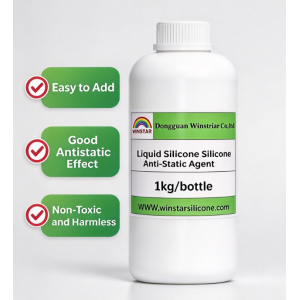
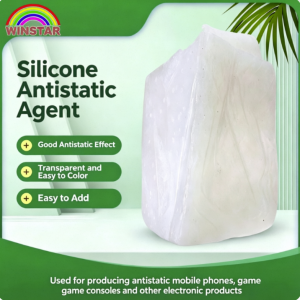
Our silicone antistatic agent is an ionic modified silicone oligomer additive for internal blending.
Important note: This product is an antistatic modifier additive, NOT conductive silicone rubber. It needs to be mixed uniformly with vinyl HCR silicone compound or LSR liquid silicone before vulcanization. It is not a surface spray coating.
Working Principle
This antistatic agent is based on specially modified silicone ionic structure. After evenly dispersed inside silicone matrix, it gradually forms stable charge dissipation channels inside the silicone. It quickly guides static charge away from the surface instead of relying on moisture absorption from air. It maintains stable surface resistance under low humidity environment, and will not easily precipitate or migrate out to contaminate contact surfaces. It is platinum-friendly and will not poison the addition curing system during vulcanization.
Key Advantages
✅ Platinum catalyst compatible — no curing inhibition for addition-cure silicone
✅ Low humidity dependence — stable antistatic performance even in dry workshop
✅ Low blooming, non-migratory — will not pollute chips, optical lenses and PCBA
✅ Good transparency retention — suitable for clear and translucent silicone products
✅ Minimal impact on mechanical properties — barely affects original hardness, tensile strength, tear strength and compression set
✅ Wide temperature resistance — stable during compression molding, extrusion and LSR injection
✅ RoHS & REACH compliant — food-grade and medical-grade formula available on request
✅ Adjustable surface resistance — can be tailored from 10⁸ to 10¹¹ Ω/sq by dosage
Suitable Materials & Application Fields
- Compatible with: HCR high consistency vinyl silicone rubber, LSR liquid silicone, RTV two-part silicone
- Typical finished silicone products: ESD protective silicone sleeves, semiconductor sealing gaskets, electronic insulating silicone pads, optical silicone films, dust-proof silicone rollers, test fixture silicone parts, wearable device silicone components
- Target industries: Semiconductor packaging, electronic assembly, optical display, new energy, medical equipment, precision testing
Operation Guide
- Add this antistatic agent into silicone compound / LSR A component before mixing with curing agent.
- Mix fully at low speed to achieve uniform dispersion; avoid high shear heating that triggers premature reaction.
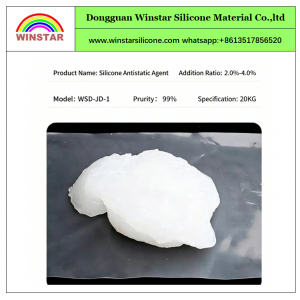
- Recommended addition ratio: 2% ~ 6% by weight, adjust dosage according to target surface resistance requirement.
- Complete vulcanization following your original silicone curing temperature and time.
- Run small lab trial first before mass production to confirm resistance, transparency and mechanical performance.
Specification Table
| Item | Parameter |
|---|---|
| Product Type | Internal blending silicone antistatic additive |
| Appearance | Colorless / light pale yellow transparent liquid |
| Active Content | ≥98% |
| Viscosity (25℃) | 50–300 mPa·s (customizable) |
| Surface Resistance of cured silicone | 10⁸ ~ 10¹¹ Ω/sq (adjustable by dosage) |
| Working Temperature Range | -50℃ ~ 220℃ |
| Storage | Cool, dry, away from direct sunlight and strong oxidants |
| Shelf Life | 8 months under sealed proper storage |
| Compliance | RoHS, REACH; support FDA / LFGB customized grade |
Safety Instruction
Operate in a well-ventilated workshop. Wear chemical resistant gloves and protective goggles. Keep away from open flame and strong oxidizing agents. MSDS and TDS technical datasheet can be provided upon request.
FAQ (Pre-sales Questions)
Q1: Can this antistatic agent be used for platinum cured LSR liquid silicone?
A: Yes, it is formulated specially for platinum addition silicone system, no cure inhibition. It also works for HCR peroxide vulcanized silicone.
Q2: Will this additive make my transparent silicone turn yellow?
A: Our standard grade has low yellowing tendency. For high-transparency optical silicone, we can supply anti-yellow customized version.
Q3: Can I get different surface resistance values?
A: Yes. Higher addition dosage brings lower surface resistance. We can give dosage suggestion based on your target Ω/sq.
Q4: Does it leave oil residue or contaminate electronic contact surfaces?
A: It is low migration type. When used within recommended dosage, blooming and surface contamination risk is greatly reduced compared with traditional hygroscopic antistatic agents.
Q5: Can I mix it with color paste and other silicone additives?
A: Most silicone color pastes are compatible. We suggest small compatibility test when using multiple additives together.
Troubleshooting (Common Problems & Solutions)
Q1: Why is the surface resistance still very high after adding the antistatic agent?
Cause: Insufficient addition dosage; uneven mixing, poor dispersion inside silicone; the silicone base material contains inhibitors that block antistatic channels.
Solution: Increase the dosage gradually following our suggestion; extend mixing time and use suitable dispersion equipment; test with pure blank silicone gum first to exclude interference from other additives.
Q2: Why does my silicone fail to cure after adding this antistatic agent?
Cause: Overdose of antistatic additive; the antistatic agent reacts with other amine or sulfur-containing additives in your formula.
Solution: Reduce addition ratio back to recommended range; check color paste, release agent and other additives to confirm they are platinum compatible.
Q3: Why do white precipitates or blooming appear on silicone surface after vulcanization?
Cause: Excessive addition beyond saturation limit; improper high-temperature post-curing; incompatible auxiliary additives.
Solution: Reduce dosage; lower post-curing temperature or shorten post-curing time; remove incompatible additives from your formula.
Q4: Why does the silicone transparency drop and become cloudy after adding?
Cause: Poor compatibility between antistatic agent and your base silicone; uneven dispersion.
Solution: Choose our high-transparency customized grade; optimize mixing process to avoid local agglomeration.
Q5: Why is the antistatic effect weak in low humidity environment?
Cause: Traditional hygroscopic antistatic agents rely on air moisture to work; the chosen product type is humidity-sensitive.
Solution: Switch to our low-humidity modified grade; confirm surface resistance test is done under actual workshop humidity condition.
Q6: Why does the silicone surface feel oily or slippery after demolding?
Cause: Antistatic agent migrates out to surface due to overdose; incompatible with your silicone base gum.
Solution: Reduce dosage; test compatibility with your specific silicone base before mass production.
Contact Us
If you are tired of dust attraction, ESD damage, blooming and unstable antistatic performance from your current additives, get our silicone antistatic agent sample for lab test first.
Send us your target surface resistance, silicone type (HCR / LSR / RTV), curing system and application industry. We will recommend the right grade, dosage formula, TDS and quotation.
- Hi, Winstar Silicone company, we are interested in your product silicone color masterbatch, could you please offer some free samples to us? Our company address: ***LA,USA
- Hello Winstar, our product is compression molding product,could you advise which peroxide curing agent to use ?
- Hi friend, we have some problem in silicone to PVC bonding, that bonding strength is not well at all, how to improve it please ?