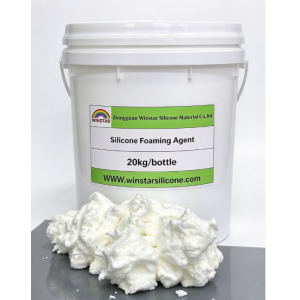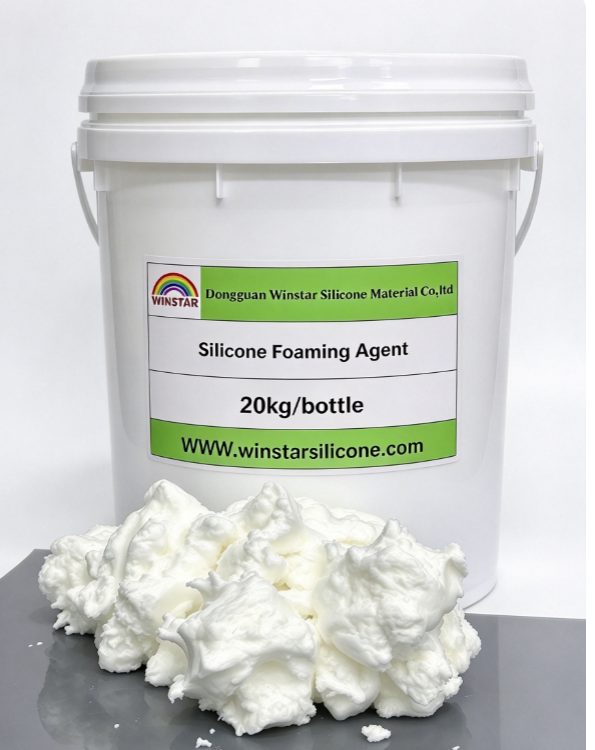
Silicone Foaming Agent
1. Definition
Silicone foaming agent is a special additive incorporated into solid compounded silicone rubber or liquid silicone rubber. It generates gas via thermal decomposition (chemical foaming) or expands by heating (physical foaming with microspheres). During the crosslinking and vulcanization of silicone, a microporous sponge structure is formed for manufacturing foamed silicone sponge products. It is divided into two main categories: chemical foaming agents and physical foaming microspheres.
- Chemical foaming agent: Releases N₂ / CO₂ upon high-temperature decomposition.
- Physical foaming microsphere: Thermoplastic shell encapsulates low-boiling solvent; the shell expands to form pores when heated, without decomposing to generate gas.
2. Characteristics (Mainstream Odorless Grade for Compounded Silicone Rubber)
- Appearance: White paste or white powder; food-grade types are usually paste for better dispersion and no dust pollution during rubber mixing.
- Foaming temperature matches silicone vulcanization range: 140~180℃. Foaming proceeds synchronously with vulcanization to avoid cell collapse or rupture.
- Cell structure: Closed-cell (mainstream), open-cell structure available upon adjustment; fine and uniform cells.
- Stability: No decomposition at room temperature for safe storage; low decomposition residues. Odorless grade resists yellowing after post-curing.
- Compatibility: Compatible with DBPMH, DCP and platinum curing systems. Ordinary foaming agents may poison platinum catalysts; special odorless foaming agents are required for platinum systems.
- Foaming ratio: 1.5~4 times; finished product density 0.3~0.8 g/cm³, minimum down to approx. 0.2 g/cm³ (depends on dosage).
3. Advantages
- Weight reduction: Greatly lowers the weight of silicone products and saves raw material costs.
- Shock absorption & cushioning: Porous structure with excellent compression resilience for sealing and shock buffering.
- Thermal & acoustic insulation: Closed-cell structure delivers low thermal conductivity for good heat insulation and sound absorption.
- Wide temperature resistance: Inherits silicone substrate properties; long-term service from -50℃ to 220℃, excellent aging, ozone and weather resistance.
- Electrical insulation: Maintains good electrical insulation after foaming.
- Food-grade option available: Odorless formulation for food contact and medical devices.
- Processing adaptability: Suitable for compression molding, extrusion and calendering silicone processes.
4. Applications
- Sealing parts: Foamed silicone sealing strips, gaskets, foam seals for cabinets and lamps.
- Shock absorption & cushioning: Electronic equipment cushion pads, shock sponge, anti-vibration gaskets.
- Thermal insulation: Household appliance thermal strips, pipe insulation sleeves, high-temperature equipment thermal sheets.
- Extruded profiles: Foamed silicone tubes and foamed silicone profiles.
- Compression molded custom parts: Foamed silicone sheets, sponge silicone gaskets, keypad foam.
- Food & medical industry: Food-contact foamed silicone gaskets, medical buffer sponge (corresponding food/medical certifications required).
5. Application Method (Most commonly used for solid compounded silicone rubber)
- Mixing on two-roll mill: Thin-pass silicone base rubber on the mill, add fillers and color masterbatch sequentially. Add foaming agent and vulcanizing agent at last. Mix uniformly at low roll temperature to prevent premature foaming. Ensure homogeneous dispersion of foaming agent, otherwise uneven cell size occurs.
- Molding processes
- Compression molding: Mold temperature 160~180℃, holding pressure for 1~5 min. Reserve expansion space for material feeding.
- Extrusion: Oven temperature segmented 150→160→180℃ for continuous vulcanization and foaming.
- Post-treatment: Post-cure at 200℃ for 2~4 hours if required, to remove volatile small molecules, reduce odor and improve stability.
For liquid addition-cure silicone foaming: Use dedicated foaming agent / foaming microspheres. Mix A & B components, vacuum degas then heat for curing. Sulfur-containing ordinary foaming agents are forbidden for platinum systems, which will cause curing failure.
6. Addition Ratio (by weight: 100 parts silicone base rubber)
- Conventional closed-cell foaming: 1~3 phr (1%~3%), medium foaming ratio, density 0.5~0.8 g/cm³.
- High foaming & low density: 3~5 phr (3%~5%), higher expansion ratio, density 0.3~0.5 g/cm³.
- Physical expandable microsphere foaming agent: Normal dosage 1~3 phr, finer cells and lower product shrinkage.
Note: Higher dosage leads to higher foaming ratio. Excessive addition causes cell rupture, product shrinkage and decreased mechanical strength. Lab trial is mandatory to verify cell structure, density and vulcanization matching.
7. Packaging Specifications (General commercial standard)
- Sample package: 1kg/bag, 2kg/bag (sealed aluminum foil bag), for R&D trial.
- Industrial bulk: 25kg/drum (plastic drum with inner PE liner).
- Paste foaming agent: 5kg, 10kg plastic drum.
Storage: Keep in cool, dry and dark place, away from heat source. Avoid direct sunlight and high temperature. Shelf life generally 6~12 months.
- Hi, Winstar Silicone company, we are interested in your product silicone color masterbatch, could you please offer some free samples to us? Our company address: ***LA,USA
- Hello Winstar, our product is compression molding product,could you advise which peroxide curing agent to use ?
- Hi friend, we have some problem in silicone to PVC bonding, that bonding strength is not well at all, how to improve it please ?