Conductive Silver Paste
1. Product Definition
Conductive silver paste is a type of conductive ink. It is a functional paste made by dispersing silver powder (conductive filler), binder resin, solvent and additives. It is a single-component thermosetting conductive material, mainly applied by screen printing. After curing, it forms a highly conductive silver film, widely used for conductive circuits, electrodes and interconnection in electronic products.
2. Product Description
Appearance: Silver-grey viscous paste with strong thixotropy. Slight sedimentation may occur during storage; uniform consistency can be restored after slow stirring without coarse particles. After screen printing and thermal curing, the resin forms a solid film, and silver particles contact each other to build conductive paths. The cured silver film can be printed on PET, PC, FR4, glass, ceramic and other substrates. It features excellent conductivity and solderability.
3. Product Characteristics
- Color: Metallic silver / silver-grey after curing
- Ultra-low sheet resistance; resistance can be customized according to requirements
- Good thixotropy: no bleeding, sharp printed line edges
- Fine particle size, suitable for high-mesh screen printing for fine patterns
- Good flexibility of cured film, withstands slight bending
- Good adhesion to various plastic and rigid substrates
- Different curing versions available: medium temperature, low temperature, UV curable
4. Advantages
- Extremely high electrical conductivity, suitable for low-resistance and high-current circuits
- Excellent solderability, easy soldering for component connection
- Good thermal conductivity
- Stable electrical performance under normal environment
- Fine printing performance for narrow-line precision circuits
- RoHS & REACH compliant grades available
Limitation: Higher cost than carbon paste; silver migration and sulfidation may occur under high temperature & high humidity environment without protective layer.
5. Application Instructions
- Substrate pretreatment: Clean substrate surface to remove oil, dust and hand sweat to guarantee adhesion and stable resistance.
- Stirring: Stir slowly and fully before opening the lid. Avoid high-speed stirring to prevent air bubbles. Mild sedimentation during storage is normal, stir evenly before use.
- Printing: Screen printing is the main process. Recommended polyester mesh: 200–350 mesh; squeegee hardness: 65–80°.
- Viscosity adjustment: Add dedicated thinner of this product if viscosity is too high. Recommended dosage: 1%~5%, stir while adding. Do NOT use other incompatible diluents.
- Curing reference (general):
- Medium-temperature type: 120~130°C for 30 min; or 150°C for 10~15 min; IR tunnel oven: ~170°C short baking.
- Low-temperature type: 80~100°C long baking for heat-sensitive flexible films such as PET.
- Cleaning: Clean screen and squeegee with dedicated cleaning solvent (DBE, butyl cellosolve, etc.) immediately after printing.
- Post-inspection: Measure sheet resistance and adhesion only after full cooling. Incompletely cured film will show unstable resistance and poor adhesion.
6. Packaging, Storage & Shelf Life
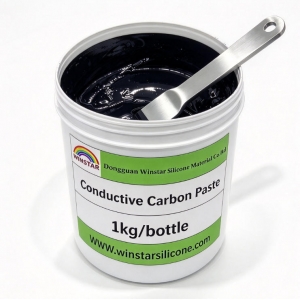
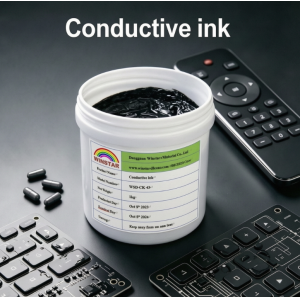
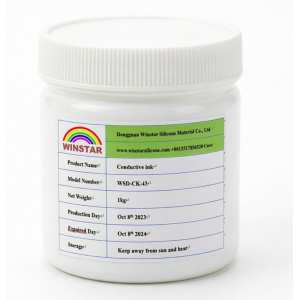
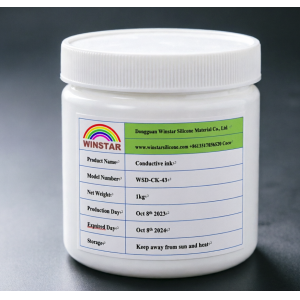
- Package: Standard plastic pail packaging: 1kg 20kg. Custom packaging available upon request. Sealed bucket with product grade, batch number, production date and safety label.
- Storage: Store in cool, dark place at 5~25°C, away from heat and direct sunlight. Do NOT freeze. Keep away from high temperature and high humidity.
- Shelf life: 12 months for unopened original package under recommended storage. Use quickly after opening; repeated opening causes solvent evaporation and viscosity rise.
7. Typical Applications
Membrane switches, flexible circuits, PCB conductive traces, touch sensor electrodes, RFID antenna, solar cell electrodes, chip bonding, EMI shielding, electronic component interconnection.
Technical Data Table (Typical Physical & Electrical Properties)
| Item | Specification | Test Condition / Remark |
|---|---|---|
| Appearance | Silver-grey viscous paste | Visual inspection, 25℃ |
| Solid Content | 70 ~ 85 wt% | TGA thermogravimetric analysis |
| Silver Content | 65 ~ 82 wt% | TGA |
| Viscosity | 80 ~ 150 Pa·s | Brookfield, 10 rpm, 25℃ |
| Fineness (Particle Size) | ≤10 ~15 μm | Grind gauge / Hegman gauge |
| Density | 3.2 ~ 4.2 g/cm³ | 25℃ |
| Cured Film Thickness | 8 ~ 20 μm | After printing & curing |
| Volume Resistivity | 1.5 ×10⁻⁵ ~ 5 ×10⁻⁵ Ω·cm | Four-point probe |
| Sheet Resistance | 2 ~ 8 mΩ/□ @12μm cured film | Four-point probe |
| Adhesion | 5B (ASTM D3359) | Cross-cut tape test on PET/PC |
| Hardness of cured film | HB ~ H | Pencil hardness test |
| Elongation / Flexibility | Slight bending acceptable | No crack under small bending |
| Solderability | Excellent | Tin-lead / lead-free solder dipping |
| Curing Temp (Medium temp grade) | 120~150℃ | 10~30 minutes |
| Storage Temperature | 5 ~ 25 ℃ | Keep away from freeze & sunlight |
| Unopened Shelf Life | 12 months | Original sealed packaging |
- Hi, Winstar Silicone company, we are interested in your product silicone color masterbatch, could you please offer some free samples to us? Our company address: ***LA,USA
- Hello Winstar, our product is compression molding product,could you advise which peroxide curing agent to use ?
- Hi friend, we have some problem in silicone to PVC bonding, that bonding strength is not well at all, how to improve it please ?