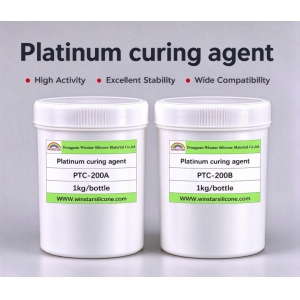
Two-Component Platinum Vulcanizing Agent | Addition Cure Platinum Curing Agent for Silicone Rubber
you are running silicone molding, extruding or calendering lines, you may have met these frustrating production troubles: Peroxide vulcanizing agents leave unpleasant odor, white blooming, and acidic by-products on finished silicone parts. Your clear silicone products turn yellow after heat aging and fail food contact or medical compliance tests. You struggle with high shrinkage, unstable tear strength, and lots of rejected parts. Worse still, many platinum curing agents on the market are easy to be poisoned, causing partial tacky surface, inconsistent curing and huge waste of raw silicone compound. You need a reliable two-component platinum vulcanizing system that cures cleanly, stably, and matches your production process.
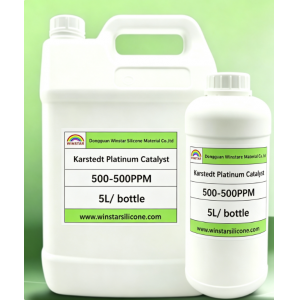
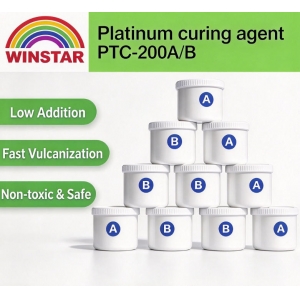
Our two-component platinum vulcanizing agent is an addition-cure platinum catalyst system, consisting of Component A (platinum catalyst) and Component B (cross-linker).
Important note: This product is a vulcanizing agent for silicone rubber, NOT silicone rubber itself. It must be mixed with silicone gum / HCR silicone compound before molding.
Working Principle
This platinum addition curing system works via hydrosilylation reaction. The platinum catalyst triggers cross-linking between vinyl groups on silicone polymer and Si-H groups on crosslinker. No decomposition by-products are generated during vulcanization. Once fully crosslinked, the silicone network achieves stable, high-performance elastic structure.
Key Advantages
- Odorless, non-blooming, no acidic residue after curing
- Ultra-low shrinkage, excellent dimensional stability for precision silicone parts
- Anti-yellowing performance, keeps high transparency for clear silicone products
- Good mechanical properties: high tear strength, tensile strength and low compression set
- Supports FDA, LFGB, food-contact and medical-grade silicone formulation
- Adjustable curing speed, suitable for compression molding, extrusion and calendering
- Clean curing system, no post-cure fumes that pollute workshop environment
- Stable activity, low inhibition risk under standard production control
Suitable Materials & Application Fields
- Compatible with: Vinyl HCR silicone rubber, vinyl silicone compound
- Typical products: Silicone kitchenware, baby nipples, food-grade silicone molds, medical silicone parts, transparent silicone tubes, silicone sealing gaskets, electrical insulation silicone components
- Industries: Food contact, medical, household, automotive, electronic sealing
Operation Guide
- Mix Component A and Component B according to recommended ratio uniformly with your silicone compound.
- Avoid contact with sulfur, tin-cured silicone residue, amine, latex and heavy metal contaminants during mixing and molding.
- Follow the recommended molding temperature and curing time.
- Complete molding within the usable pot life after mixing.
- Do not reuse leftover mixed material.
Specification
| Item | Parameter |
|---|---|
| Type | Two-component addition platinum vulcanizing agent |
| Appearance | Translucent liquid / paste (customizable) |
| Mixing ratio | Custom (common 1:1 or A/B add-on ratio) |
| Curing type | Heat addition cure |
| Storage | Cool & dry, away from direct sunlight |
| Shelf life | 6 months under proper storage |
| Compliance | RoHS, REACH, support FDA / LFGB test |
Safety Instruction
Operate in well-ventilated workshop, wear gloves and protective goggles. Keep away from flame and heat source. MSDS and TDS documents can be provided upon request.
FAQ (Pre-sales Questions)
Q1: Can this platinum vulcanizing agent be used for liquid silicone LSR? A: This grade is designed for HCR high-consistency silicone rubber. We have separate LSR platinum catalyst if you need.
Q2: Does it need post-curing after molding? A: Post-curing is optional, mainly for food and medical grade to reduce extractables.
Q3: Can I mix it with peroxide vulcanizing agent together? A: Not recommended. Peroxide system will poison platinum catalyst and cause curing failure.
Q4: Can you customize curing speed for my production line? A: Yes, we adjust activity formula according to your molding temperature and cycle time.
Troubleshooting (Common Problems & Solutions)
Q1: Why is part of my silicone surface still sticky and not fully cured after molding? Cause: Platinum catalyst gets poisoned by sulfur-containing substances, tin silicone residue, amine pigments, contaminated mold release agent or latex pollutants. Even tiny amounts of inhibitor will stop the hydrosilylation reaction locally. Solution: Check all pigments, color pastes and release agents to confirm they are platinum-cure compatible. Fully clean molds and mixing equipment to remove peroxide or tin silicone residues. Run a small trial batch before mass production.
Q2: Why is the curing speed slow and inconsistent across different batches? Cause: Insufficient addition dosage of platinum vulcanizing agent; uneven mixing between A/B component and silicone rubber; mold temperature is lower than the required curing temperature. Solution: Recalculate and calibrate the addition ratio; extend mixing time to achieve homogeneous dispersion; raise mold temperature to the recommended range and keep temperature stable during production.
Q3: Why does the transparent silicone turn yellow after heat aging test? Cause: Excessive addition of platinum catalyst; overcuring under too high temperature or long holding time; the base silicone gum itself has poor anti-yellowing property. Solution: Strictly follow our recommended dosage; shorten curing time or reduce molding temperature; select anti-yellow vinyl silicone compound for transparent formulations.
Q4: Why do bubbles form inside my finished silicone parts after vulcanization? Cause: Air trapped inside the compound during mixing; the curing rate is too fast, so bubbles cannot escape before crosslinking finishes. Solution: Carry out vacuum degassing sufficiently after mixing; contact us to adjust the formula for slower cure speed if degassing time is limited on your line.
Q5: Why is the pot life very short after mixing A and B with silicone? Cause: The ambient workshop temperature is too high; the mixing proportion of A and B components is wrong. Solution: Store mixed compound in a cool environment before molding; strictly follow the mixing ratio we provide for your process.
Q6: Why do I get low tear strength and poor elasticity after curing? Cause: Improper vulcanization dosage; insufficient crosslinking; poor dispersion of the platinum system in silicone. Solution: Optimize additive amount; extend curing time properly; improve mixing process to guarantee uniform dispersion of catalyst and crosslinker.
Contact Us
If you are tired of unstable curing, blooming, yellowing and high rejection rates from your old vulcanizing agent, get our platinum vulcanizing agent sample for lab test first. Send us your silicone formula, molding process and target application, we will offer tailored dosage suggestion, technical support and quotation.
- Hi, Winstar Silicone company, we are interested in your product silicone color masterbatch, could you please offer some free samples to us? Our company address: ***LA,USA
- Hello Winstar, our product is compression molding product,could you advise which peroxide curing agent to use ?
- Hi friend, we have some problem in silicone to PVC bonding, that bonding strength is not well at all, how to improve it please ?