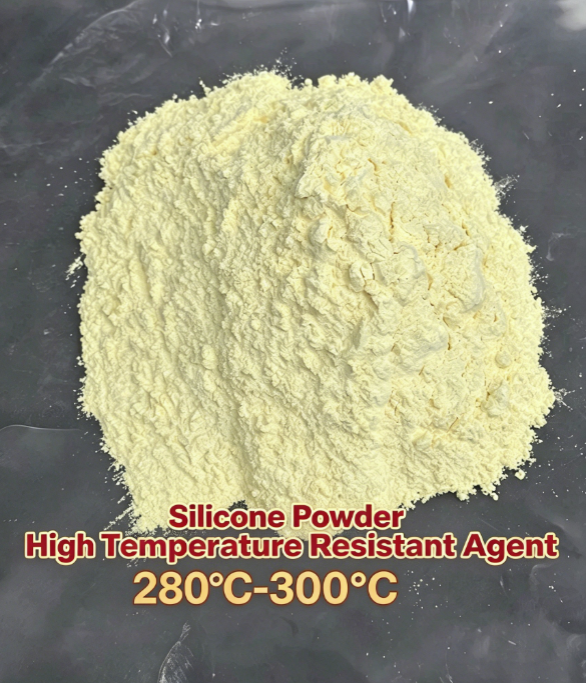
Silicone Heat-Resistant Powder (Rare Earth Heat Stabilizer)
1. Product Overview
A powder-form rare-earth heat stabilizer specifically designed for HTV (high-temperature vulcanized) silicone rubber. It significantly improves high-temperature aging resistance, preventing hardening, embrittlement and cracking of silicone products under long-term 250–300 °C working conditions. It is the most widely used heat-resistance additive for silicone rubber in the industry.
2. Physical & Chemical Properties
(Delivered as the Feishu/Lark sheet above — 6 parameters: appearance, recommended dosage, bulk density, moisture content, particle size, heat resistance.)
| Silicone Heat-Resistant Powder (Rare Earth) — Physical & Chemical Properties | ||
| Parameter | Typical Value | Remarks |
| Appearance | Light yellow / beige fine powder (some grades: reddish powder) | Good flowability |
| Recommended dosage | 1–3 wt% of total silicone compound | Typically start at 1.5 wt% |
| Bulk density | 0.4–0.7 g/cm³ | Loose powder |
| Moisture content | ≤ 1.0% | Keep sealed & dry |
| Particle size (D50) | 2–8 μm | Easy to disperse during mixing |
| Heat resistance | Without additive: long-term 180–200 °C; With additive: long-term 250–280 °C, short-term up to 300 °C | Inhibits high-temperature oxidation, hardening and cracking |
3. Working Mechanism
Under high temperature with oxygen, the methyl side groups of silicone rubber oxidize into free radicals, triggering crosslinking, hardening and cracking. In oxygen-free environments, the main chain depolymerizes and softens. The rare-earth heat-resistance powder works by:
- Scavenging free radicals produced by oxidation, interrupting the oxidative chain reaction.
- Adsorbing trace acid/alkali impurities in the system that catalyze degradation.
- Recycling/regenerating in oxygen environments, long-term stabilizing the siloxane main chain and preventing ring-opening depolymerization.
4. Key Advantages
- Powder form — highly compatible with fumed silica & silica micropowder; easy dispersion in mixing.
- Minimal impact on transparency (light-yellow grade suits translucent silicone).
- Combines heat aging resistance, tear resistance and oil resistance.
- Compatible with peroxide curing systems (BPO, DBPH) — run a small trial to confirm no cure delay.
- ⚠️ Drawbacks: overdosing reduces tensile strength and deepens color; avoid red-grade powder for clear/transparent products.
5. Applicable Systems & Applications
- For: HTV solid silicone rubber — extrusion & compression molding.
- Not recommended for: LSR (liquid silicone rubber) — poor dispersion; use liquid heat stabilizers instead.
- Typical products: high-temperature sealing rings, oven silicone parts, heating-tube sleeves, engine/high-temp gaskets, high-temp cable silicone insulation.
6. Processing Guidelines
- Addition timing: add together with fillers during kneading (early/middle stage of mixing) — not at the last minute, to avoid agglomeration.
- Mixing: knead thoroughly in internal mixer or two-roll mill for uniform dispersion.
- Curing: standard peroxide curing (BPO, DBPH) works; always run a small cure-curve test first.
- Post-curing: 2nd-stage oven post-cure (200 °C × 2–4 h) releases volatiles and improves heat resistance further.
7. Packaging, Storage & Safety
- Packaging: 25 kg or 50 kg bags, PE-film lined.
- Storage: keep sealed, dry and cool; avoid moisture absorption; shelf life 12 months.
Safety: ordinary inorganic rare-earth powder, not classified as dangerous goods. Wear a dust mask during handling; keep away from food.
- Hi, Winstar Silicone company, we are interested in your product silicone color masterbatch, could you please offer some free samples to us? Our company address: ***LA,USA
- Hello Winstar, our product is compression molding product,could you advise which peroxide curing agent to use ?
- Hi friend, we have some problem in silicone to PVC bonding, that bonding strength is not well at all, how to improve it please ?